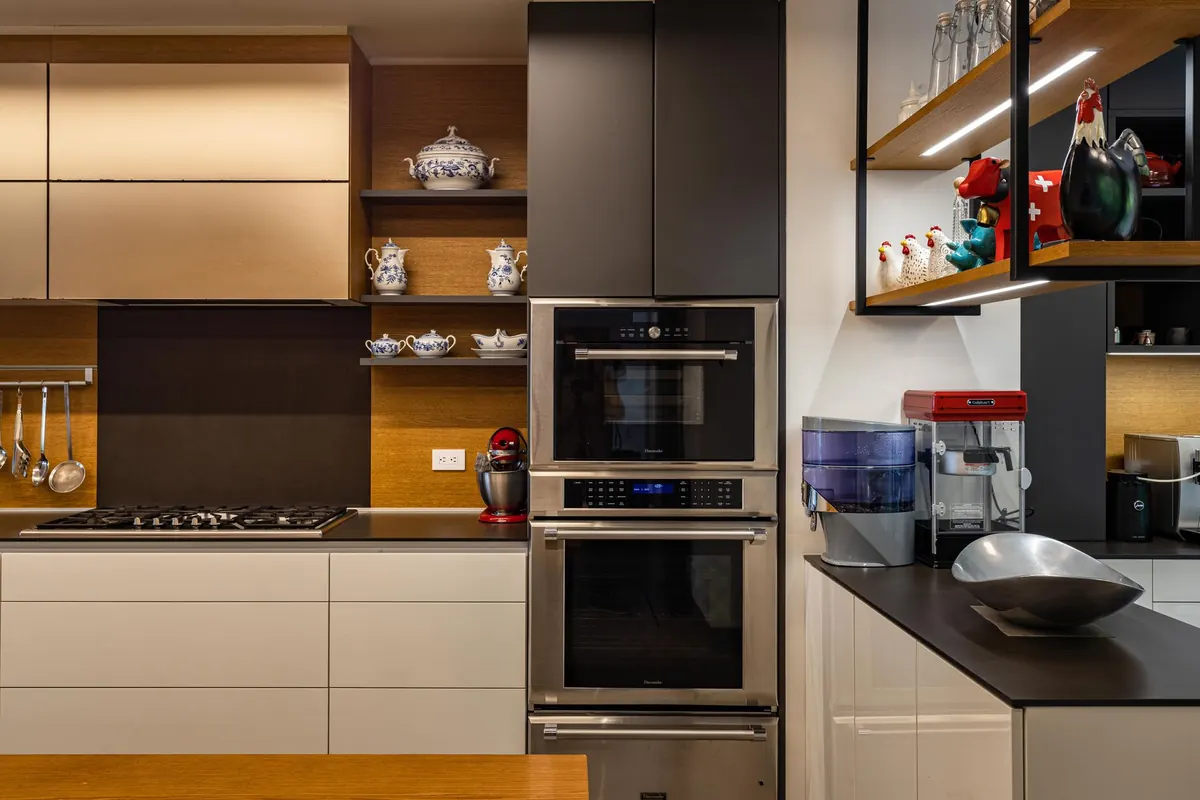
Open shelves in a kitchen make a promise: everything you reach for, you can see. Then life arrives — a mug from a holiday, a half-used bag of lentils, a note from the school fair — and the promise turns into a job you keep meaning to do. The good news is that open shelving does not need to be sparse, or styled like a shop display. It needs a few rules, applied consistently.
Get those rules right and your shelves will still look considered at seven in the morning on a Tuesday, not just on the day you arranged them.
Decide what each shelf is for
Before you move a single jar, give every shelf a job. Not a category — a job. “Drinking” is a category. “The mugs and glasses we use every morning” is a job, and it tells you straight away what does not belong there.
A shelf without a job collects whatever is nearest when you are unpacking the shopping. It becomes a holding bay, and holding bays always look messy, however neatly you stack them.
Stand back and describe each shelf out loud in one sentence. If you cannot, that is the one to tackle first.
Height matters as much as content. Keep the shelf between shoulder and eye level for the things you touch daily. Use the lower shelf for heavier items — stacked bowls, a bread bin, a jug of utensils — because you can lift them down safely. The highest shelf can take the occasional pieces: a pretty jug, a spare cafetière, the serving platter that appears at Christmas.
Build in height, depth and breathing room
Clutter is often not too much stuff. It is stuff of the same size and shape lined up in a row, which reads as a queue rather than a display. Break the pattern deliberately.
- Vary the height. A tall bottle of olive oil beside a low stack of bowls is more restful to look at than five objects of identical height.
- Push some things back and bring others forward. Using the full depth of the shelf stops it looking like a stockroom.
- Leave a gap at one end. Roughly a hand's width of bare shelf gives the eye somewhere to stop, and it makes the whole shelf feel calmer.
- Group in small clusters. Three jars, or a stack of plates with a bowl on top, reads as one object rather than three. Odd numbers tend to sit more comfortably, though this is a habit rather than a law.
Crockery: make the everyday look deliberate
Open shelves are usually the crockery shelf, and that is fine. Mugs in a straight row or on hooks look tidy; a tangle of mismatched mugs looks like a cupboard turned inside out.
- Keep six to eight mugs out and store the rest. If you have a favourite shape, buy more of that one and let the others go.
- Stack plates in threes or fours. Anything taller starts to look like a canteen, and you will knock the top one every time.
- Nest bowls, but keep the stack low enough to lift the bottom one out with one hand.
- Give the odds and ends a home: a shallow dish or small tray for the bottle opener, the tea strainer, the spoon that lives by the kettle.
If your crockery is a mixed set
Mixed is fine, but mixed needs a link. It might be colour — all white and cream with one dark accent — or material, such as stoneware only, or shape, where everything is round. Choose the link, hold to it, and move anything that breaks it somewhere else.
Jars, tins and dry goods
Decanting into jars is not really about looking like a delicatessen. It is about making the shelf honest: you can see how much pasta is left, and you notice the flour is running low before you start baking.
- Choose jars that fit the shelf depth with the lid on. A jar you have to angle in will always end up shoved to the back.
- Keep one jar style across the shelf. Different heights are fine; different designs are not.
- Label the lid or the base rather than the front of the jar if you want a cleaner line. A strip of masking tape and a pen does the job perfectly well.
- Stand anything liquid on a lower shelf, or on a tray with a lip, so a slow leak does not travel along the timber.
- Only decant what you will use in a few months. Long-life packets can stay in their original packaging in a cupboard.
One practical point: full jars of flour and sugar are heavy. If your shelves are on brackets, check that the fixings suit the load and the wall type. If you are unsure, ask someone qualified to take a look before you load a shelf up.
Plants and herbs on a kitchen shelf
A plant earns its place twice in a kitchen: it looks alive, and if it is a herb, you will actually use it. But shelves near a hob get warm, greasy and dry, which most soft-leaved herbs dislike.
- Keep parsley, coriander and mint in a bright spot away from direct heat, and turn them regularly so they grow evenly rather than leaning at the window.
- A trailing plant softens a straight shelf line beautifully. Keep the pot small and stand it in a saucer.
- Water plants at the sink, let them drain properly, then put them back. Water rings on painted shelves are stubborn.
- Two or three plants is usually plenty. Once foliage starts hiding the jars behind it, you have gone past the point.
Everyday habits that keep clutter away
Styling lasts about a fortnight unless you build in a small routine. This one takes ten minutes and works on a single shelf at a time, so it never becomes a whole-afternoon job.
- Empty one shelf completely.
- Wipe it down and let it dry.
- Put back only what has been used in the past seven days.
- Send everything else to a cupboard, a donation bag or the bin.
- Tackle a different shelf next week.
Do the same before Christmas and at the start of summer. A seasonal edit keeps the shelves current without a full restyle.
When it still looks wrong
If a shelf feels busy even after a clear-out, the cause is usually one of four things. Too many small items — gather them onto one tray. Everything the same height — add a single tall object, such as a bottle or a vase. Too many colours — settle on a wood tone, a white or cream, and one accent, then stick to it.
And sometimes the missing piece is the least useful one: a bowl you simply like, a small framed print, a stone from a beach. Shelves that hold only practical things read as storage. One object that has no job at all is usually what makes a kitchen shelf look like part of a home.
Start with a single shelf this weekend. Clear it, give it a job, put back less than you took off, and leave a gap at one end. The rest will follow.
Photo: Gustavo Galeano Maz / Pexels